


|
|
ISSN 3080-8022(Print) |
| Magazine Introduction | More... |
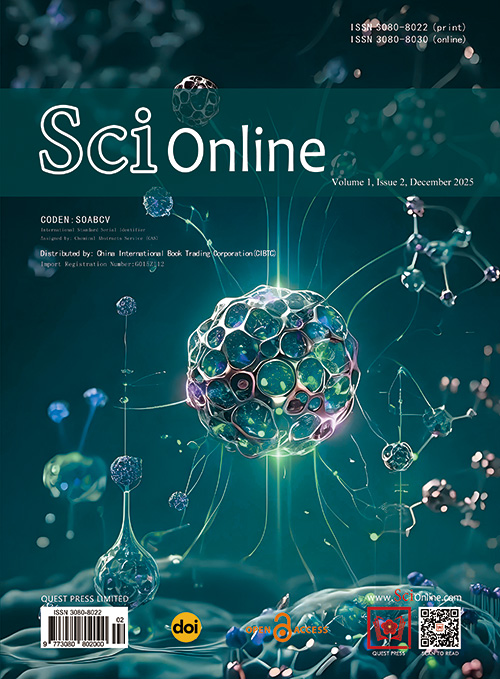
English Title: Sci Online
Chinese Title: 《科学在线》
ISSN:
ISSN 3105-7519 (Print)
ISSN 3105-7527 (Online)
CODEN: XINNA7 (Assigned by Chemical Abstracts Service, CAS)
Publication Model: Gold Open Access under the Creative Commons Attribution 4.0 International License (CC BY 4.0). All content is permanently and freely accessible.
Publisher: QUEST PRESS LIMITED
Publication Frequency: Quarterly
Publication Language: English
Submission Language: English
Distribution Support: China International Book Trading Corporation (CIBTC)
Import Registration Number: G015Z122
Journal Introduction
Sci Online is an international, peer-reviewed academic quarterly published by Quest Press Limited, adhering to the rigorous Gold Open Access publishing model. Published in English, the journal is dedicated to advancing the frontiers of natural sciences and engineering technology. All published articles are provided with immediate and permanent free access on its official platform, aiming to break down knowledge barriers and promote barrier-free development of global scientific exchange and progress.
Core Focus and Distinctive Features
Frontier Interdisciplinary Research: Focuses on fundamental and forward-looking scientific questions in the fields of natural sciences and engineering technology worldwide, with particular encouragement for original, transformative research that reflects multidisciplinary integration.
Open Science Advocate: Strictly adheres to the Gold Open Access model, utilizing the Creative Commons Attribution license (CC BY) to maximize the global dissemination, reuse, and academic impact of research results.
Benchmark of Academic Excellence: Employs a high-standard international double-blind peer review system, overseen by an editorial team composed of distinguished scholars from around the world to ensure the originality, data integrity, and reliability of published research.
Digitalization and International Perspective: Relies on an advanced online publishing and dissemination system to ensure rapid publication and broad reach. The editorial board and reviewer network span the globe, reflecting a fully internationalized academic vision.
Scope of Submission
Sci Online welcomes submissions of original research articles, systematic reviews, and perspective commentaries across all fields of natural sciences and engineering technology, including but not limited to:
Mathematics and Physical Sciences
Chemistry and Materials Science
Life Sciences and Biomedicine (including basic research, translational medicine, and public health)
Earth and Environmental Sciences
Information Science, Computer Science, and Artificial Intelligence
Various Engineering Disciplines (Mechanical, Electrical, Chemical, Civil, Aerospace, etc.)
Submission Guidelines
Language: The journal accepts manuscripts in English.
Submission System: All submissions must be made through the journal's online submission system.
Manuscript Requirements: Submissions must include: Abstract, Keywords; Full names and affiliations of all authors; Brief biography of the first author.
Formatting: Please prepare manuscripts according to the detailed templates and guidelines provided on the journal's official website.
Peer Review: All submissions will undergo rigorous double-blind peer review by international experts.
Aims and Vision
The overarching vision of Sci Online is to become an influential benchmark international academic journal within its related disciplines. We are committed not only to publishing outstanding research that advances the fields but also to cultivating a vibrant global scholarly community. By practicing the principles of Open Science, we empower researchers worldwide to jointly address major challenges in societal development.
Abstracting and Indexing (Under Application)
The journal is actively applying for inclusion in major domestic and international abstracting and indexing databases, including:
International Databases: Science Citation Index Expanded (SCIE), Ei Compendex, Scopus, INSPEC, MEDLINE/PubMed, Embase, Global Health, DOAJ, Google Scholar, etc.
Regional/Chinese Databases: China National Knowledge Infrastructure (CNKI), WanFang Data, VIP Information, Baidu Scholar, Chaoxing, Longyuan Journals, Changjiang Wenku, Macau Virtual Library, Xinhuanet Academic China, etc.
Open Access and Copyright Policy
All content published by Sci Online is licensed under the Creative Commons Attribution 4.0 International License (CC BY 4.0). This license allows third-party users to share and adapt the articles for non-commercial purposes (i.e., reading, downloading, copying, distributing, printing, searching, or linking to the full text), provided that appropriate credit is given to the author(s) and a link to the original publication is provided. Authors retain copyright of their articles and may use them for any non-commercial purpose. The full license terms can be found at: https://creativecommons.org/licenses/by/4.0/. Submission of a manuscript is considered as granting Quest Press Limited the license to publish the article as the original publisher.
Join Us
To continuously enhance the journal's academic quality and international reputation, Sci Online is now openly recruiting for the following positions from the global academic community: Editor-in-Chief, Associate Editors, Editorial Board Members, and Peer Reviewers. We eagerly welcome distinguished scholars with outstanding achievements, great passion, and a shared belief in Open Science principles to join our professional team and co-create a premier academic product.
Online Application for Editorial/Reviewer Positions: http://tg.scionline2025.com/01/bw.asp
Online Submission System: http://tg.scionline2025.com/01/
英文刊名: Sci Online
中文刊名: 科学在线
国际刊号:
ISSN 3105-7519 (印刷版)
ISSN 3105-7527 (在线版)
CODEN 码: XINNA7
(国际标准连续出版物标识符·全球唯一标识符,由美国化学文摘社 CAS 分配)
出版模式: 金色开放获取 (Gold OA),遵循知识共享署名 4.0 国际协议 (CC BY 4.0),全文永久免费获取
出版机构: QUEST PRESS LIMITED
出版频率: 季刊
出版语言: 英文
投稿语言: 英文
发行支持: 国图集团 (CIBTC)
进口备案刊号: G015Z122
期刊简介
Sci Online 是由 Quest Press Limited 出版,以严格的黄金开放获取模式出版的国际同行评议学术季刊。本刊以英文出版,致力于推动自然科学与工程技术的前沿发展,在其官方平台上对所有发表的文章提供即时、永久的免费访问,旨在打破知识壁垒,促进全球科学交流与进步的无障碍发展。
核心聚焦与特色
前沿交叉研究:聚焦全球自然科学与工程技术领域基础性、前瞻性的科学问题,特别鼓励具有原创性和变革性、体现多学科交叉的研究。
开放科学倡导者:严格遵守黄金开放获取模式,采用知识共享署名许可协议 (CC BY),最大化研究成果的全球传播、再利用与学术影响力。
学术卓越标杆:高标准的国际双盲同行评议制度,由来自全球的杰出学者组成的编辑团队监督,确保发表研究的原创性、数据完整性和可靠性。
数字化与国际视野:依托先进的在线出版传播系统,保障快速出版与广泛传播。编委会与审稿人网络遍布全球,彰显国际化学术视野。
征稿范围
《Sci Online》欢迎接收所有自然科学与工程技术领域的原创研究论文、系统综述及观点评论投稿,包括但不限于:
数学与物理科学
化学与材料科学
生命科学与生物医学 (包括基础研究、转化医学及公共卫生)
地球与环境科学
信息科学、计算机科学与人工智能
各类工程学科 (机械、电子、化工、土木、航空航天等)
投稿指南
语言:本刊接受英文稿件。
投稿系统:所有投稿须通过本刊在线投稿系统进行。
稿件要求:投稿须包含:摘要、关键词;所有作者的全名及所属机构;第一作者简介。
格式:请根据本刊官方网站提供的详细模板和指南准备稿件。
同行评议:所有投稿将经过国际专家的严格双盲同行评议。
宗旨与愿景
《Sci Online》的总体愿景是成为相关学科领域内具有重要影响力的标杆性国际学术期刊。我们不仅致力于发表推动学科进步的杰出研究,也旨在培育充满活力的全球学术共同体。通过践行开放科学理念,我们助力全球研究者共同应对人类社会发展的重大挑战。
文摘与索引 (申请中)
本刊正在积极申请被国内外主要文摘和索引数据库收录,包括:
国际数据库:Science Citation Index Expanded (SCIE), Ei Compendex, Scopus, INSPEC, MEDLINE/PubMed, Embase, Global Health, DOAJ, Google Scholar 等。
区域/中国数据库:中国知网 (CNKI)、万方数据 (WanFang Data)、维普网 (VIP)、百度学术、超星、龙源、长江文库、澳门虚拟图书馆、新华网·学术中国等。
开放获取与版权政策
《Sci Online》发表的所有内容均根据知识共享署名 4.0 国际许可协议 (CC BY 4.0) 授权。该协议允许第三方用户在非商业目的下 (即阅读、下载、复制、分发、打印、搜索或链接至全文) 共享和改编文章,前提是适当注明作者身份并链接至原始出版物。作者保留其文章的版权,并可用于任何非商业目的。完整许可条款请访问:https://creativecommons.org/licenses/by/4.0/。作者投稿即视为授予 Quest Press Limited 作为原出版方出版文章的许可。
加入我们
为持续提升期刊学术质量与国际声誉,《Sci Online》现面向全球学术界公开招募以下职位:主编、副主编、编委及同行评议专家。我们热切期待在相关领域成就卓越、富有热情、并认同开放科学理念的杰出学者加入我们的专业团队,共铸学术精品。
编辑/审稿人职位在线申请:http://tg.scionline2025.com/01/bw.asp
在线投稿系统:http://tg.scionline2025.com/01/
| Past Views | More... |
 |
||||
|
||||
| Cheng Tang | ||||
| Abstract : The rise of artificial intelligence(AI) places higher demands on the capabilities and qualities of the first secretaries stationed in villages, and the traditional educational management model is difficult to adapt to the needs of the new situation. Focusing on AI empowering the educational management of first secretaries stationed in villages, this paper, through an analysis of the current situation,systematically explores the important significance of AI in improving the efficiency of educational management, enhancing the pertinence of training, and promoting the balance of resources. It also identifies the problems existing in content adaptation, method innovation, assessment and feedback, etc. From four dimensions—construction of an intelligent training system, data-driven management, optimization of collaboration mechanisms, and improvement of support systems—specific implementation strategies are proposed. AI, by empowering with technology, breaks the limitations of traditional educational management, provides a precise and efficient path for improving the capabilities of first secretaries stationed in villages, and has important practical value for promoting the construction of talent teams in rural revitalization. | ||||

| |
||||
|
||||
| Ye Tian | ||||
| Abstract:Internet public opinion in Colleges and universities has the characteristics of fast transmission speed, wide range, diverse means of transmission, sensitive content, diverse communication subjects and strong interaction. Colleges and universities should strive to improve the management system, clarify the division of responsibilities, improve the management mechanism, upgrade monitoring means, improve ideological understanding, enhance coping ability, expand the propaganda position, and strengthen the guidance of public opinion. | ||||
| |
||||
|
||||
| Yunjie Xiao Zhe Liu Wenhui Liu | ||||
| Abstract: In the field of building construction, unsafe behaviors of construction workers are a critical factor contributing to safety accidents. This paper delves into relevant key technologies based on multi-source data fusion technology and proposes a precise identification method for unsafe behaviors of construction workers through innovative practices such as constructing a fused data acquisition system, establishing an intelligent identification and early warning system, and implementing model dynamic optimization strategies. This method contributes to enhancing the accuracy and real-time performance of unsafe behavior identification. | ||||
| |
||||
|
||||
| Wenxuan Sun Otgonbayar Nanzaddorj | ||||
| Abstract: In the context of accelerated digital transformation, Human Resource Sharing Service Centers (HRSSCs) as centralized and standardized HR management models face core pain points such as data security, process efficiency, and trust mechanisms. Blockchain technology, with its decentralized, tamper-proof, and traceable characteristics, offers a new approach to addressing HRSSC management challenges. This paper systematically examines blockchain applications in HRSSC scenarios including employee information management, compensation settlement, recruitment vetting, training certification, and performance evaluation. Through case studies of three HRSSCs across different industries, the research evaluates practical effectiveness from four dimensions: efficiency improvement, cost control, risk prevention, and experience optimization. The findings demonstrate that blockchain technology can significantly reduce data verification costs and enhance process transparency and response speed for HRSSCs. However, challenges remain in technology implementation, standard unification, and privacy protection. Finally, targeted optimization suggestions are proposed based on case insights to provide references for large-scale blockchain adoption in HRSSCs. | ||||
| |
||||
|
||||
| Yanlin Liu Otgonbayar Nanzaddorj | ||||
| Abstract: In the era of accelerated digital economy penetration, emerging technologies such as artificial intelligence, big data, and cloud computing are deeply integrating with human resource management, driving traditional HR models toward digitalization, intelligence, and personalization. This transformation not only reshapes corporate HR processes and structures but also profoundly impacts employee career development. Based on the core characteristics of technology empowerment, this study systematically examines HR model transformations across dimensions including recruitment, training, performance management, and compensation incentives. Through empirical analysis of 12 enterprises across various industries, the research investigates how management model changes influence employee career development (career competency enhancement, career path expansion, job satisfaction, and career stability), while identifying challenges in the transformation process. The findings reveal that technology-enabled HR model reforms significantly enhance career development, yet issues like uneven technology adoption, digital divide, and lack of humanistic care constrain full realization of these benefits. Finally, the study proposes targeted optimization recommendations from corporate, employee, and government perspectives to facilitate synergistic win-win outcomes between technological empowerment and employee career development. | ||||
| |
||||
|
||||
| Min Peng Yi Zhang Xiaoxia Wang Qiao Huang Jinhua Guo Bei Gong Tiemei Shen | ||||
| Abstract : Objectives With the aging population in China, the cognitive function of older adults has become a concern. However, few studies have evaluated the risk factors for changes in cognitive function in older adults with cardiovascular disease in China. Methods We conducted a population-based cross-sectional study of 3, 270 participants using a multistage, stratified, cluster-sampling procedure. Binary and multiple logistic regression analyses were used to explore the factors influencing cognitive impairment. Results The prevalence of cognitive impairment in older adults with cardiovascular disease was 27.7%, which was higher than that in the general older adult population. Multivariate regression analyses revealed that age (OR: 1.023; 95% CI: 1.011, 1.036), educational level (primary school or below: OR: 0.150; 95% CI: 0.094, 0.239; junior high school: OR: 0.258; 95% CI: 0.170, 0.392), monthly family income (RMB2, 000-4, 000: OR: 2.618; 95% CI: 1.949, 3.517; RMB4, 000-6, 000: OR: 1.809; 95% CI: 1.413, 2.316), place of residence (rural region or towns: OR: 0.665; 95% CI: 0.524, 0.843; small or mid-sized cities: OR: 0.710; 95% CI: 0.539, 0.936), medication usage, frequency of social activities, care from family or friends (OR: 1.420; 95% CI: 1.135, 1.777), hearing ability (OR: 0.754; 95% CI: 0.618, 0.920), walking ability (OR: 0.479; 95% CI: 0.387, 0.591), and symptoms of anxiety and depression were all significantly associated with cognitive impairment. Conclusion The high prevalence of cognitive impairment among older adults with CVD underscores the urgent need for integrated care models that address both cardiovascular and cognitive health. A comprehensive and systematic prevention and treatment program should be developed, incorporating early screening, multidisciplinary collaboration, and tailored interventions targeting the identified modifiable risk factors. Future longitudinal studies are needed to confirm these associations and explore underlying mechanisms. | ||||
| |
||||
|
||||
| Jing Wang Zhengliang Chen Chenfei Hu | ||||
| Abstract: Objective To analyze the effectiveness of DC-CIK immunotherapy combined with chemotherapy in patients with advanced breast cancer. Methods A total of 64 patients with advanced breast cancer admitted to our hospital from March —— March 2023 were included in the study, divided into two groups based on different treatment methods: traditional group and combined group, each consisting of 32 cases; the traditional group received conventional chemotherapy, while the combined group received both conventional chemotherapy and DC-CIK immunotherapy. The treatment outcomes and immune markers were compared between the two groups. Results Compared to the traditional group, the overall effective rate of treatment was significantly higher in the combined group (P<0.05); compared to the traditional group, the levels of CD3+, CD3+/CD4+, and NK cells were all better in the combined group (P<0.05). Conclusion In the treatment of advanced breast cancer, combining DC-CIK immunotherapy with chemotherapy can achieve ideal therapeutic effects and improve immune markers; therefore, it is worth actively promoting and scientifically applying this approach in the field. | ||||
| |
||||
|
||||
| Jingxing Sha Teng Dong Xiangtong Kong | ||||
| Abstract: Contemporary college students are at a critical juncture of rapid social change and personal growth, facing multiple pressures such as academic, interpersonal, employment, and emotional pressures. Their mental health status is increasingly becoming a focus of social attention. Emotional management ability, as a core component of individual emotional intelligence, refers to an individual's ability to perceive, understand, express, regulate, and apply their own and others' emotions. This study aims to explore the intrinsic relationship and mechanism between the emotional management ability of college students and their mental health level. | ||||
| |
||||
|
||||
| Wangling Qin Lei Geng Xiangtong Kong | ||||
| Abstract: The ecological protection and high-quality development of the Yellow River Basin has been elevated to a major national strategy. As the core nodes of the cultural service system in the basin, urban libraries shoulder the important mission of inheriting Yellow River culture, serving the public, and promoting regional collaboration. However, at present, urban libraries in the Yellow River Basin generally face problems such as unbalanced development, isolated resources, homogenized services, and insufficient influence of cultural brands. This paper aims to explore the construction of a cultural linkage development mechanism for urban libraries in the Yellow River Basin. By analyzing its necessity and practical difficulties, it proposes a systematic and operational linkage development path from multiple dimensions including top-level design, resource integration, service innovation, technological empowerment, and guarantee systems, with the goal of forming a "resource sharing, complementary advantages, coordinated development, and win-win cooperation" library community in the basin. This is expected to provide theoretical support and practical guidelines for the protection, inheritance, and promotion of Yellow River culture, as well as the integrated construction of public cultural services in the basin. | ||||
| |
||||
|
||||
| Teng Dong Jingxing Sha Xiangtong Kong | ||||
| Abstract: With the deepening development of the knowledge economy era and the continuous deepening of higher education reform, cultivating high-quality talents with innovative spirit and practical ability has become the core mission of universities. The ability of student self-management, as a key core competency for individual growth and success, is not only related to their learning efficiency and quality of life during university, but also the cornerstone for their lifelong development and sustainable competitiveness after entering society. However, the traditional student management model in universities generally has problems such as strong administrative color, lack of student subjectivity, and single management methods, which seriously restrict the stimulation of students' autonomy and the comprehensive development of their abilities. | ||||
|
| ||
|
| ||
|
| ||
|
| ||
|
| ||
|
| ||
|
| ||
|
| ||
|
| ||
|
| ||
|
| ||
|
| ||